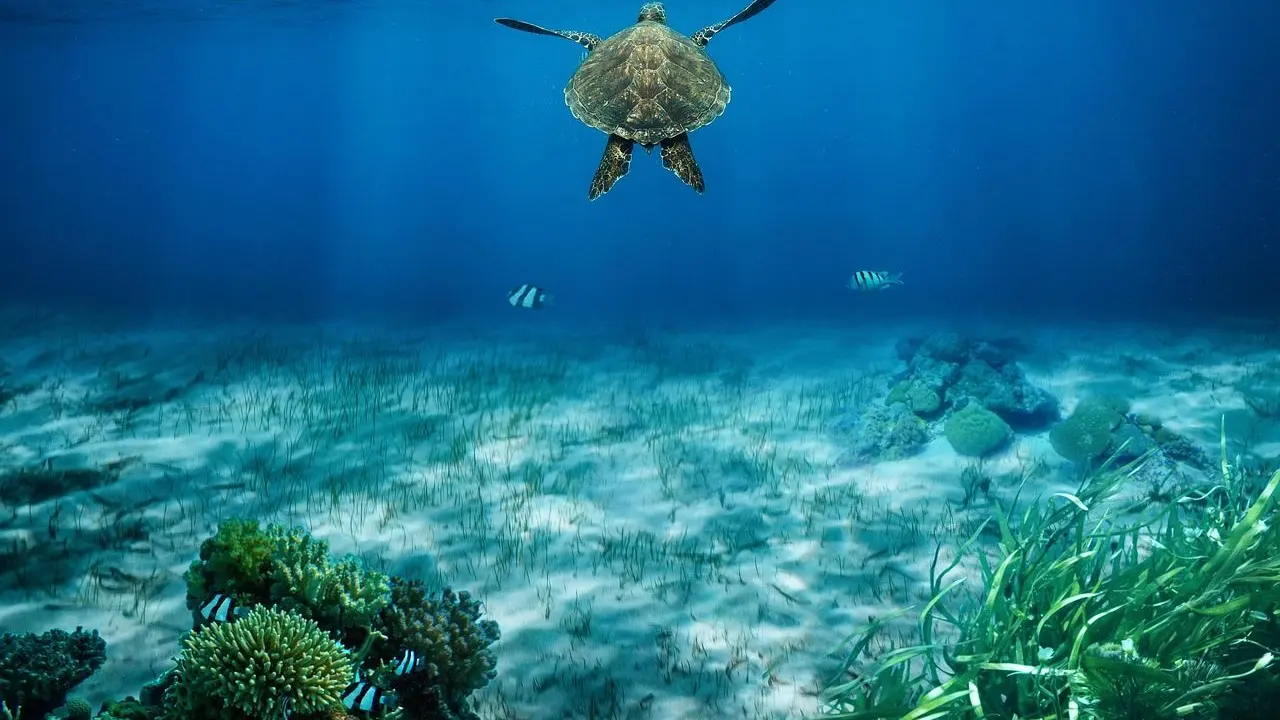
Wondering if underwater grass really matters for climate? Seagrass meadows carbon storage comes down to burying organic carbon in sediment. The amount varies hugely from place to place.
This guide is part of the wider topic of coastal ecosystem services.
| Item | Value |
|---|---|
| Share of the ocean surface occupied by seagrass | 0.1% |
| Organic carbon buried by seagrass worldwide each year | 27-44 Tg |
| Share of organic carbon burial in the global ocean | 10-18% |
| Bahamas organic carbon stock in top-meter sediments | 0.42-0.59 Pg |
| Bahamas organic carbon accumulation rate | 2.1-2.9 Tg annually |
| Organic carbon burial across 3 Australian estuaries | 16 ± 3 to 130 ± 40 g m-2 yr-1 |
These figures come from a 2023 study of Bahamas seagrass in Communications Earth & Environment and a 2019 study in Marine Ecology Progress Series. Figures can change as new research appears, so check the source before you rely on them.
How seagrass meadows lock carbon into sediment
Seagrasses are flowering plants that form highly productive ecosystems in coastal areas of all continents except Antarctica, according to the Bahamas study. Researchers group them with salt marshes and mangrove forests under the label blue carbon, which refers to the carbon accumulation capacity of vegetated coastal habitats, as the 2019 Australian study defines it.
The carbon ends up in the sediment beneath the meadow. Scientists usually measure it in three ways:
- Stock: how much organic carbon sits in the sediment, often counted in the top meter.
- Burial or accumulation rate: how much new organic carbon is added each year.
- Source: whether the buried carbon came from seagrass itself, algae, mangroves or land.
The Bahamas team set out to estimate all of these for one region, covering sediment stocks, burial rates and the changing sources of carbon over time.
Why seagrass matters for the global carbon cycle
Seagrasses occupy only 0.1% of the ocean surface, yet they can bury 27-44 Tg of organic carbon annually. That is 10-18% of organic carbon burial in the global ocean, according to the 2023 Bahamas paper. Tg stands for teragrams, a unit used for large national and global carbon budgets.
Carbon is not the only benefit. The same paper lists a wide range of ecosystem services from seagrass:
- Supporting biodiversity
- Supporting fisheries
- Regulating water quality
- Coastal protection
- Recreational and cultural values
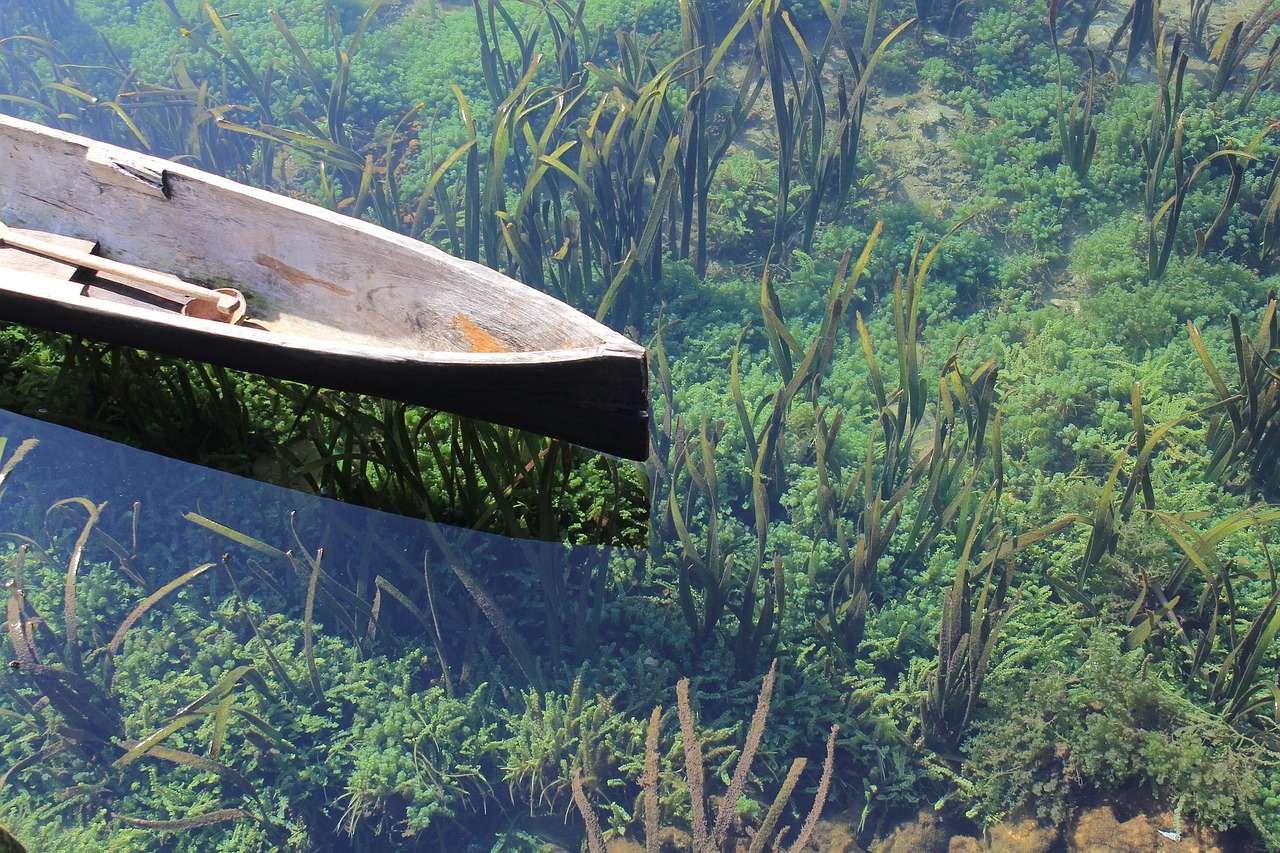
Seagrass rarely grows alone. Mangroves are covered in the guide to mangrove ecosystem services, and reefs are covered in the guide to coral reef ecosystem services.
What the Bahamas study found
The Bahamas accounts for up to 40.7% of the documented global seagrass area, with a meadow of 66,990-92,524 square kilometres, as reported in the December 2023 paper. Yet carbon data from this region were scarce, so the authors sampled 10 seagrass meadows across an island chain.
Their estimate is that Bahamas seagrass meadows store 0.42-0.59 Pg of organic carbon in the top-meter sediments. The accumulation rate is 2.1-2.9 Tg annually. The authors call this a substantial global blue carbon hotspot.
The same paper reports that the discovery prompted the government of The Bahamas to develop new legislation enabling blue carbon strategies for climate change mitigation, adaptation and resilience. The authors say better local numbers are needed to support those strategies.
Why burial rates differ so much between meadows
A 2019 study looked at 4 seagrass species in 3 temperate estuaries on the east coast of Australia. Organic carbon burial rates varied by an order of magnitude, from 16 ± 3 to 130 ± 40 g m-2 yr-1, according to the published abstract.
The authors point to the mixed origin of the carbon. Isotope and carbon-to-nitrogen measurements suggested the meadows buried variable mixtures of seagrass, algal and mangrove or terrestrial material.
The Bahamas paper adds that stocks can vary considerably between habitats, depending on interrelated biogeochemical and physical factors such as:
- Seagrass traits
- Hydrodynamic conditions
- Sediment characteristics
Calcium carbonate can offset part of the benefit
The Australian team also measured calcium carbonate (CaCO3) burial, which ranged from 15 ± 11 to 188 ± 122 g m-2 yr-1. If that carbonate is precipitated by calcifying organisms in these or nearby habitats, it may offset up to 89% of the organic carbon burial across the 8 seagrass communities, per the same abstract.
What disturbance can do to a meadow’s carbon record
Sediment cores also work as a record of change. In the Bahamas, carbon made by seagrass itself (autochthonous carbon) decreased from about 1980 onwards, while cyanobacterial and mangrove contributions increased, as the authors report.
They read this as a sign of disturbance to seagrass ecosystems, likely caused by tourism and maritime traffic. The wording is cautious, so treat it as an interpretation of the cores rather than a proven cause.
The lesson from both studies is practical. Large ranges in burial rates and in carbon origin are factors that need to be considered when assessing seagrass in blue carbon and climate mitigation strategies, as the 2019 authors note. The Bahamas authors also note that data gaps remain, particularly for the Caribbean, Central America and Africa.
Frequently asked questions
What is blue carbon?
Show answer
Blue carbon refers to the carbon accumulation capacity of vegetated coastal habitats, including salt marshes, mangrove forests and seagrass meadows, as defined in the 2019 Australian study.
How much carbon do seagrass meadows bury worldwide?
Show answer
The 2023 Bahamas paper says seagrasses can bury 27-44 Tg of organic carbon annually, which is 10-18% of organic carbon burial in the global ocean.
Do all seagrass meadows store the same amount?
Show answer
No. In 3 Australian estuaries, burial rates ranged from 16 ± 3 to 130 ± 40 g m-2 yr-1, per the 2019 study.
Where does the carbon in seagrass sediment come from?
Show answer
It can come from seagrass, algae and mangrove or terrestrial material. The Australian authors found variable mixtures of these in the meadows they studied, as stated in their abstract.
Where is the largest documented seagrass area?
Show answer
As of the December 2023 paper, The Bahamas is reported to hold up to 40.7% of the documented global seagrass area, according to the study.