Worried about what a storm could do to your coast? Natural coastal protection from storms comes from mangroves, salt marshes, reefs and seagrass that slow waves, though the protection depends on the place and the size of the storm.
This page sits within the wider topic of coastal ecosystem services, which covers what healthy coasts do for the people who live beside them.
| Item | Value |
|---|---|
| Share of the world’s population living in coastal areas and small islands | More than one third |
| Share of people living within 10 m of sea level | More than 10% |
| Lives lost in the December 2004 Indian Ocean tsunami | Over 250,000 |
| Deaths caused by Hurricanes Katrina and Rita (2005) | Over 1,500 |
| Valuation studies in one review published since 2010 | 31 of 41 |
| Effect of losing coral reef protection on annual expected global flood damages | Would double them |
These figures come from a 2011 review of wetlands and wave attenuation and from an economic review of coastal ecosystems and flood damage. They can change as new studies appear, so check the sources before you rely on them.
How do natural habitats slow storms and waves?
The core idea is that wetland vegetation reduces wave heights before waves reach the shore. According to the Gedan review in Climatic Change, biophysical models, field tests and natural experiments all show that wetlands reduce wave heights, property damage and human deaths.
Height of the ground matters as well. An economic review by Barbier notes that sediment trapping and sedimentation make shorelines higher, which is an important factor in how well marshes attenuate waves.
Mangrove protection is not uniform. The same review cites research suggesting it can depend on features of the forest, such as:
- the width of the forest and the slope of the forest floor
- forest density, and tree diameter and height
- the proportion of above-ground biomass held in the roots
- soil texture
- forest location, whether open coast or lagoon
Vegetation also changes the shoreline itself over time. The Gedan review points to peat accretion, which increases shoreline integrity over long timescales and so can help against accelerated sea level rise and more frequent storm inundation.
What the evidence shows for marshes and mangroves
The idea is old. Gedan and colleagues report that a hypothesis about wetlands protecting shoreline communities was formally communicated in 1971, following a catastrophic storm on the coast of Bangladesh, as described in their 2011 paper.
After the Indian Ocean tsunami of December 2004, which took over 250,000 lives, scientists observed that intact mangrove forests shielded villages from the worst destruction. They also observed that mangrove deforestation magnified storm damage and loss of life, according to the same review.
The authors ran a literature review and a small meta-analysis of wave attenuation data. They found that vegetation plays a critical role and described the evidence as overwhelming in support of established theory.
One finding is especially useful for small communities: because the relationship between wave attenuation and wetland size is nonlinear, even small wetlands afford substantial protection from waves.

Coral reefs and seagrass: different habitats, different strengths
Marshes and mangroves are not the only habitats involved. Barbier’s review says the protection from near-shore coral reefs can be significant, because their reticulated structure forms a natural barrier to storm waves.
The same review cites a global estimate by Beck and colleagues. They estimate that without the protective benefit of coral reefs, annual expected flood damages worldwide would double.
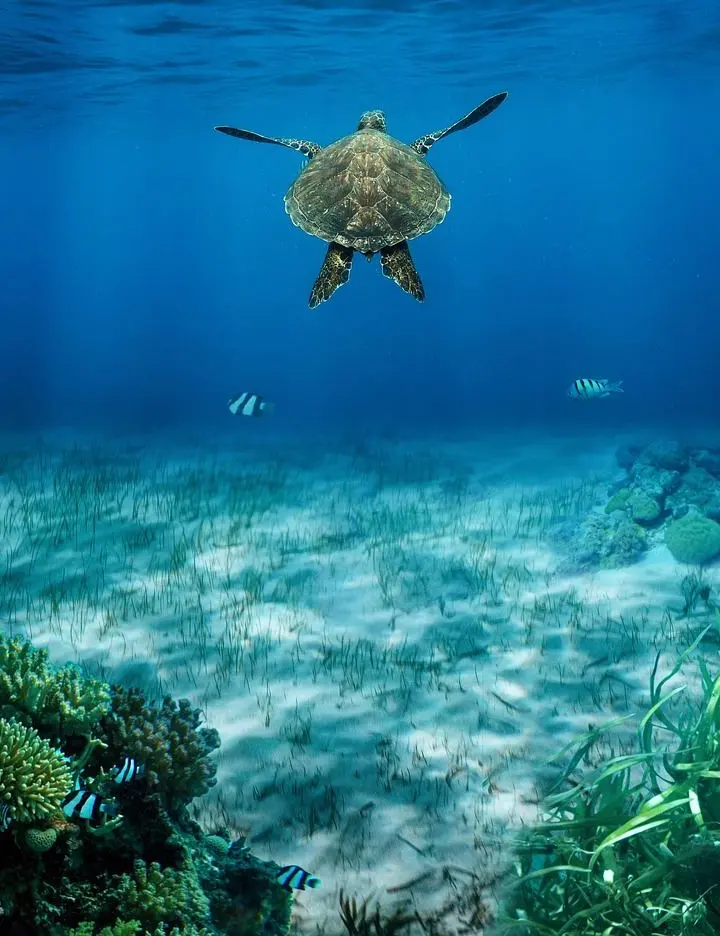
Seagrass plays a different role. The review describes seagrass meadows as more effective at stabilising shorelines than at attenuating large waves, and notes that few studies have put a value on their coastal protection.
Where natural protection reaches its limits
Habitats are not a guarantee. The Gedan review states that wetlands cannot protect shorelines in all locations or scenarios, and that large-scale regional erosion, river meandering, and large tsunami waves and storm surges can overwhelm the attenuation effect of vegetation.
There has also been real scientific debate. After the 2004 tsunami, some researchers questioned how much of the reduced damage was due to mangroves rather than correlated variables such as topography and shoreline geomorphology, as the Gedan paper recounts.
Small-scale experiments raised a related challenge. In tests with waves under 10 cm, one group concluded that common salt marsh plants do not significantly mitigate the total amount of erosion along a wetland edge. The Gedan authors answer that wave heights in storms are a different matter and conclude that the protection paradigm still stands, while noting that gaps remain in knowledge about how protection varies by context.
The evidence base is also still growing. Of the 41 studies listed in Barbier’s table, 31 have been published since 2010, yet the review says a greater range of studies is needed in more locations and for a wider variety of ecosystems.
Pairing habitats with built defences, and wider benefits
Natural and built defences can work together. The Gedan review says combining man-made structures with wetlands in ways that mimic nature is likely to increase coastal protection, and gives oyster domes as an example that can protect shorelines while restoring critical fishery habitat.
Cost is part of the appeal. Wetland protection is described as a low-cost alternative to barrier construction and a cost-effective approach for rural communities, and it does not conflict with additional measures such as early warning systems.
Storm protection is also only one benefit. Coastal wetlands support fisheries, wood and non-wood products, and tourism opportunities, which is why storm protection is usually discussed alongside other types of ecosystem services.
The same mangroves, marshes and seagrass beds also feature in climate discussions, and you can read how in our primer on blue carbon explained.
Frequently asked questions
Can marshes and mangroves stop a large storm surge?
Show answer
Not reliably. The Gedan review says large tsunami waves and storm surges can overwhelm the attenuation effect of vegetation, so these habitats offer context-dependent protection rather than a guarantee.
Do small wetlands still help?
Show answer
Yes. Because the relationship between wave attenuation and wetland size is nonlinear, even small wetlands afford substantial protection from waves, according to the Gedan review.
Do coral reefs protect coasts from storms?
Show answer
They can. Reefs close to shore act as a barrier against storm waves, and a global estimate cited in Barbier’s review suggests that losing them would double annual expected flood damages.
Do natural defences replace early warning systems?
Show answer
No. The Gedan review says wetland protection does not conflict with additional protection methods such as early warning systems, so the two can be used together.