Weighing marine protected areas benefits against the fishing limits they bring? You can expect more fish and, in some sites, new local income inside well-run reserves, but results depend on protection level, enforcement and place.
This guide is part of the wider topic of sustainable coastal development, where protected areas sit alongside planning, fisheries management and community needs.
| Item | Value |
|---|---|
| Fish biomass gain in no-take MPAs vs unprotected zones | 58.2% |
| Fish biomass gain in multiple-use MPAs vs unprotected zones | 12.6% |
| Average biomass increase inside fully protected areas (global review) | 446% |
| Share of the global ocean in any form of MPA (as of February 2024) | about 8% |
| Share of the global ocean fully or highly protected (as of February 2024) | about 3% |
| Annual revenue linked to the Medes Islands MPA in Spain | about 10 million euros |
The figures come from Mongabay’s February 2024 report on a peer-reviewed study and from PISCO’s science summary. They can change as new studies appear, so check the sources before you rely on them.
What counts as a marine protected area?
The International Union for Conservation of Nature defined a marine protected area (MPA) in 2008 as “a clearly defined geographical space, recognised, dedicated and managed, through legal or other effective means, to achieve the longterm conservation of nature with associated ecosystem services and cultural values”, as quoted in a December 2019 review in Frontiers in Marine Science.
Protection is not all-or-nothing. The same review describes a continuum of management measures, from minimal intervention, such as restricting particular activities or periods, to a total ban on direct human activities that may affect wildlife.
An October 2019 Eurofish article describes four categories used by the Marine Conservation Institute’s Atlas of Marine Protection:
- Fully protected: no extractive or destructive activities are allowed.
- Highly protected: only light extractive activities are allowed.
- Lightly protected: some protections exist, but moderate to significant extraction and impacts are allowed.
- Minimally protected: extensive extraction and other impacts are allowed while still providing some conservation benefit.
Benefits for marine life
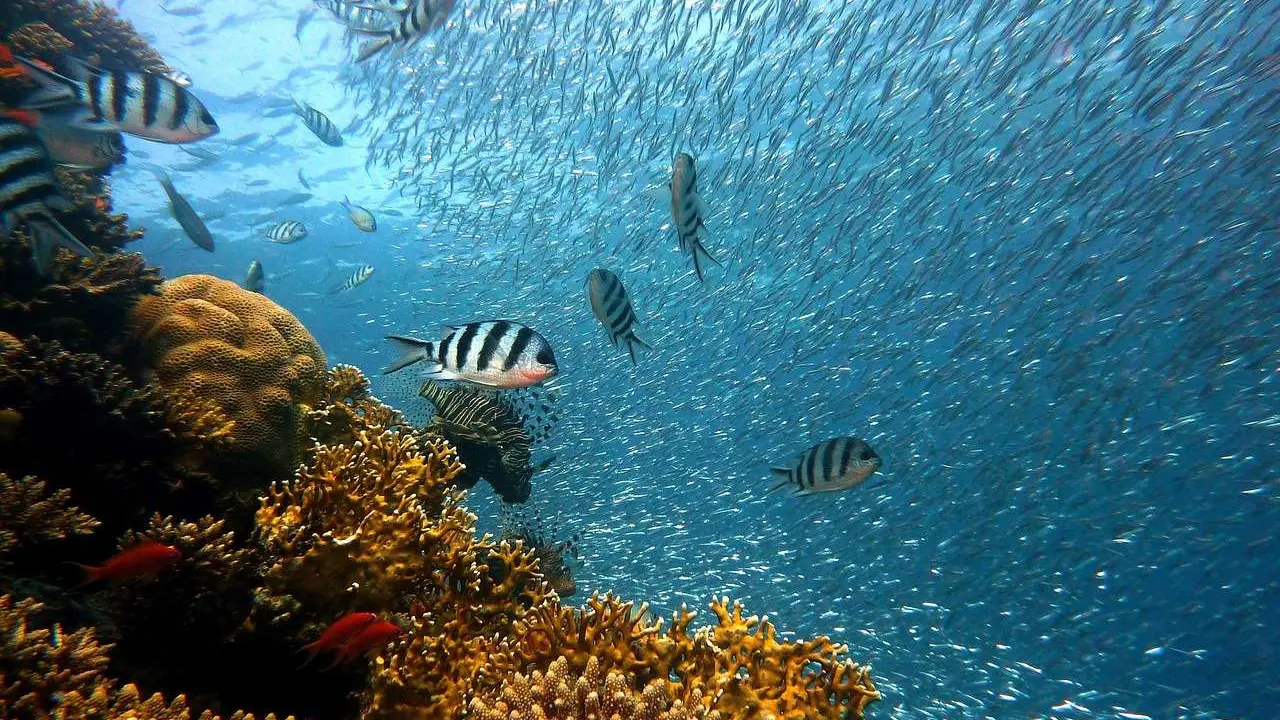
PISCO’s science summary reports that scientists have studied more than 150 fully protected MPAs around the world. A global review found that fishes, invertebrates and seaweeds show significant average increases inside fully protected areas compared with unprotected areas, as listed in PISCO’s summary.
- Biomass, the total weight of animals and plants: up an average of 446%.
- Density, the number of plants or animals in a given area: up an average of 166%.
- Body size of animals: up an average of 28%.
- Species diversity, the number of species: up an average of 21%.
The Frontiers review adds that well-designed and enforced MPAs with high levels of protection often provide conservation benefits within their boundaries beyond those of other MPA types. PISCO says protection can also help restore the natural range of ages and sizes of many species and boost the recovery of top predators and heavily fished species such as groupers.
Benefits for local economies and communities
PISCO states that effective MPAs can sustain fisheries, improve local livelihoods and promote sustainable tourism. Its main example is the Medes Islands MPA in Spain, where a fully protected area of less than 1 km2 generates revenues of about 10 million euros annually.
Almost 85% of those economic benefits come from SCUBA diving and glass-bottom boats, according to PISCO. In some well-designed MPAs the income generated can be 2-3 times greater than the management costs.
PISCO also stresses that involving stakeholders and communities is key to success, because engagement increases compliance and reduces management effort and costs. Tourism income is only one way coastal ecosystems create value; the explainer on blue carbon credits looks at another.
The economic evidence is thinner than the ecological evidence. The Frontiers review says much remains to be learned about the socio-economic effects of highly protected areas, and that apart from studies on no-take areas and fisheries, there are no meta-analyses or systematic reviews showing whether they bring extra economic benefits over other MPA types.
Where protection falls short
A boundary on a map does not stop every threat. The October 2019 Eurofish article cites an Australian Institute of Marine Science report that put hard coral in the northern Great Barrier Reef at just 14%, and it links the loss to rising water temperature and more frequent tropical cyclones.
The same article reports a Dalhousie University investigation of 727 MPAs in the European Union. It found trawl fishing was 38% higher inside protected areas than outside them. Eurofish suggests that a lack of required management objectives can give a false sense of optimism about what an MPA protects.
Warming is a pressure that no local rule can remove, so responses on land and in communities are covered in the guide to climate adaptation coastal communities.
Social trade-offs are real too. The Frontiers review notes a long tradition of free access to coastal waters, so MPAs can be contentious, and demonstrating societal benefits when use is restricted remains one of the main challenges. It concludes that potential benefits cannot all be maximised at once, because conflicting trade-offs exist both between and within ecological and socio-economic effects.
No-take or multiple-use: choosing a design
A study in the Proceedings of the National Academy of Sciences, reported by Mongabay in February 2024, used data from 14,000 fish surveys across 216 MPAs. Compared with zones without protection, no-take MPAs raised fish biomass by 58.2% and multiple-use MPAs, which allow certain forms of fishing, by 12.6%.
Both types were more than 97% likely to improve fish populations. Location mattered:
- Near populated coasts, no-take MPAs did more to boost fish populations.
- In remote locations, both types yielded similar biomass gains.
- A multiple-use MPA near a populated area performed similarly to a no-take MPA when it was adequately staffed and appropriately regulated.
The authors suggest multiple-use MPAs can offer “a viable and potentially equitable pathway to advance local and global conservation” when adequately designed and managed. An expert not involved in the study argued that full protection is more urgently needed for ecosystems such as coral reefs.
Global coverage and the 30% target
One of the targets of the Kunming-Montreal Global Biodiversity Framework is to protect 30% of the land and sea by 2030. As of Mongabay’s February 2024 report, the world remained well short of that goal.
The report says only about 8% of the global ocean was protected in some form of MPA, and only two countries had protected at least 30% of their waters. About 3% of the ocean was known to be fully or highly protected, and most other MPAs allowed moderate or even extensive fishing or other extraction.
Frequently asked questions
What is the difference between no-take and multiple-use MPAs?
Show answer
In a no-take MPA all fishing activity is banned. A multiple-use MPA allows certain forms of fishing, as described in the February 2024 Mongabay report.
Do marine protected areas make money?
Show answer
Some do. PISCO cites the Medes Islands MPA, with about 10 million euros in annual revenue, mostly from diving and glass-bottom boats. The Frontiers review cautions that much remains to be learned about socio-economic effects.
Can an MPA protect a reef from warming?
Show answer
Not by itself. Eurofish’s October 2019 article notes that MPAs cannot guard against every threat and points to hard coral decline on the Great Barrier Reef despite its protection.
Is more protection always better?
Show answer
Not always. The Frontiers review says benefits cannot all be maximised at once, and the 2024 study found that well-staffed multiple-use MPAs can perform similarly to no-take MPAs in some settings.